
The Iblis demon is a prominent and multifaceted character in Islamic doctrine. In Iblis demon in Islam, he is identified as the personal name of the Devil, often linked to Satan in Christianity.
The name Iblis is believed by some scholars to have originated from the Greek word diablos.
In the Islamic scriptures, he is also referred to as Aduw Allh (Enemy of God) and al-Shayn, which is a term generally used for a deceiver or a tempter.
In the Islamic teachings, the narrative of the Iblis demon starts at the time when humans were created. Allah having made Adam, He ordered all the angels to bow in reverence to Him.
While the angels complied immediately, Iblis was the only one who refused. His refusal was motivated by pride he thought he was a better being since he was made out of fire while humans were created from clay.
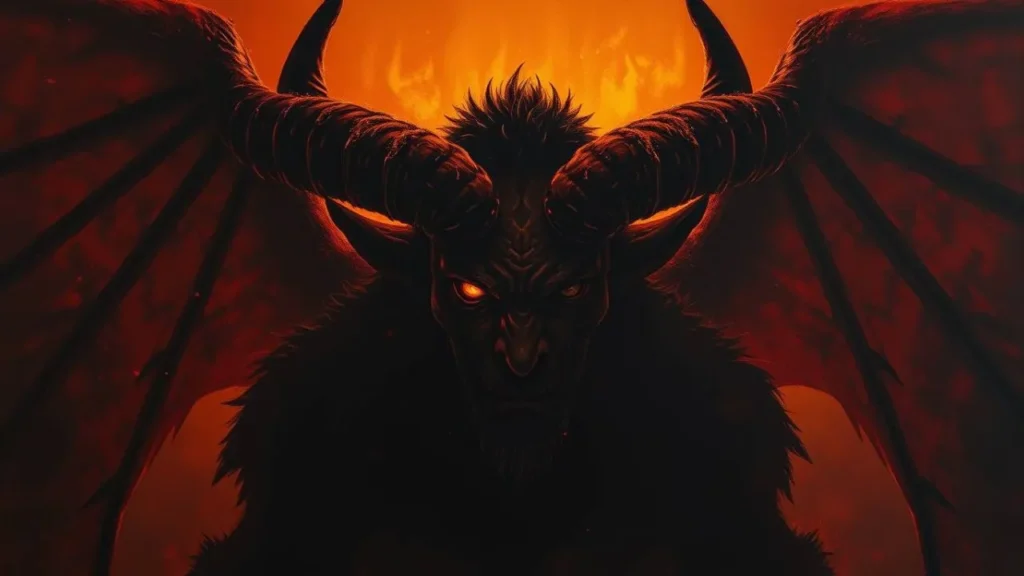
This conceit was the cause of his downfall.
Therefore, the Iblis demon in Islam due to such disobedience was expelled from the heavenly abode. But he was not instantly punished. On the contrary, he was allowed to exist until the Day of Judgment.
In the meantime, Iblis has been permitted to lead astray and tempt humans, but those who are strong in their faith and loyalty are exempted from his influence.
Iblis is said to have deceived Adam and Eve in the Garden of Eden by tricking them to eat from the forbidden tree. This led to their expulsion from paradise and the start of human trials on earth.
Who is Iblis demon in Islam?
The Iblis demon, in different Islamic traditions, is recognized as an artful tempter capable of changing forms.
Numerous accounts refer to his appearance or mysterious voice, a known figure in Arab folklore, exposing his efforts to lead even pious individuals astray. Nevertheless, such endeavors will not always succeed, particularly in the presence of strong faith.
The true identity of the Iblis demon in Islam has been the subject of numerous theological discussions. A significant point of debate has been whether Iblis was an angel or a jinn.
The arguments stem from the fact that angels are made of light and are traditionally understood as sinless, whereas jinn are made of fire and have free will.
Since Iblis disobeyed God, the majority of scholars have inferred that he must have been a jinn, albeit one who was present among the angels.
Different interpretations exist regarding his origin. Some believe the Iblis demon was always a jinn who rose to a high rank due to his devotion, placing him among angels.
Others suggest he was sent to fight rebellious jinn on earth before humans were created. There are also traditions claiming he was captured by angels and brought into the heavenly realm.
Despite these differing views, one idea remains consistent: the Iblis demon represents arrogance, disobedience, and the constant temptation that humans must resist.
His story in Islam serves as a reminder of the dangers of pride and the importance of humility and obedience to God.
Appearance of Iblis
The Iblis demon in Islam was described, before his fall, as having a unique and grand appearance, even among the ranks of the jinn.
Iblis demon in Islam, he was seen as majestic and impressive, with power that exceeded others of his kind, similar to how Lucifer is described before his fall.
After being cast out of the heavens, the form of the Iblis demon changed completely.
His body was said to be made of molten magma or brimstone, mixed with frost, and capable of shifting between different forms. His original form was often described as a massive, swirling ball of fire.
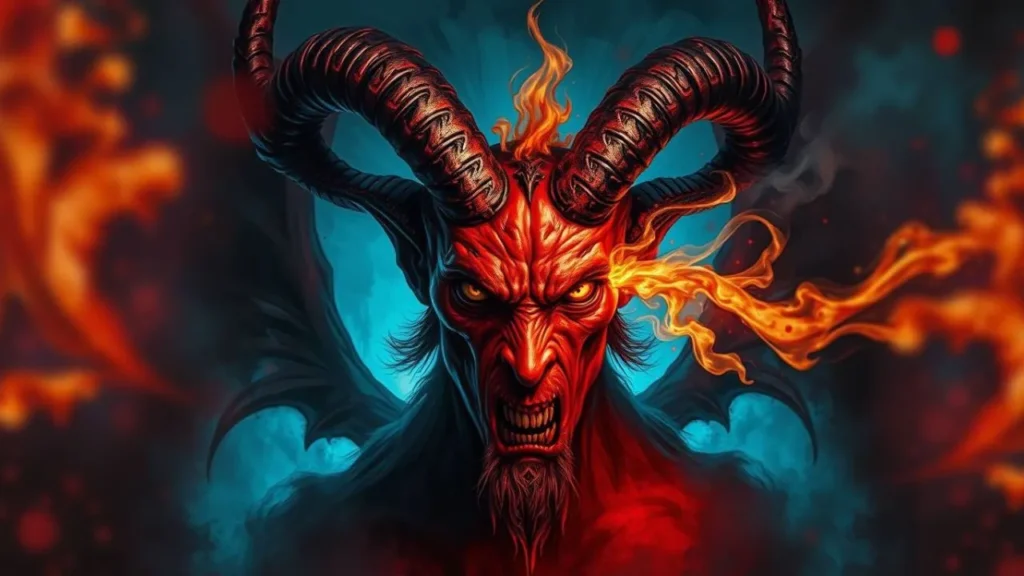
According to several Islamic scholars, when the Iblis demon appears in human form, he has seven hairs on his chin, a threatening expression, and eyes that resemble smouldering embers.
It is also said that he became blind in his right eye after Idris pierced it with a needle.
When the Iblis demon confronted John the Baptist, he took on the shape of a terrifying and unnatural creature. His body resembled that of a wild boar, his face looked like a monkey, and his eyes were long and vermin-like.
His nose pointed upward, and he had no beard. The hair on his donkey-like head was sparse and stood upright.
He was described as having four hands with six fingers, with two hands on his shoulders and two on his forehead.
The Iblis demon also had a trunk-like feature, walked with a limp, and possessed wings. In addition, he had a pair of goat horns, which were decorated with idols.
Read : 3 Most Powerful Ritual for Working with Lucifer
History and origin of Iblis demon
The Iblis demon in Islam, originally known as Azazil, was one of the Jann, created by God from Vril and destined to become the greatest among his kind.
The Iblis demon stood apart from other jinn due to his unique appearance and immense power, yet in the eyes of Heaven, he was still considered no different from the rest of the jinn.
When Jann ibn Jann rebelled against Heaven after learning that the Jann were meant to serve humanity, a war broke out between them and the angels.
During this conflict, prisoners were taken, and the Iblis demon was among those captured and brought to heaven.
Unlike the other jinn, he was deeply pious, which impressed the angels. Because of his devotion and noble nature, Iblis was allowed to join the company of angels and was elevated to their rank.
However, despite his outward angelic status, the Iblis demon in Islam remained a jinn in essence, meaning he still possessed free will.
After rising to the ranks of the angels, the Iblis demon was approached by them with a challenge.
They declared that if he could prove his worth among the Heavenly Host, he would be allowed to lead the battle against the rebellious Jann and punish them for their actions.
Iblis accepted this task and became a leader and teacher among a group of angels, taking on the role of a guardian of heaven.
As a result, the Iblis demon and his army pushed the ancient jinn to the far edges of the world, to Mount Qaf.
In response, the jinn viewed Iblis as a traitor to their kind, accusing him of aligning himself with the angels only to escape punishment and secure his position in heaven.
Rebelling in Heaven
When God created Adam, He commanded all the angels and jinn to bow before the new creation. All obeyed except the Iblis demon in Islam, who refused.
Aware of the corruption of earlier earthly beings, the Iblis demon objected when asked to prostrate before Adam.
He believed that the angels, who continuously glorify God, were superior to humans made from clay with physical weaknesses.
He also considered himself greater than the angels, as he was created from fire. Because of this arrogance and disobedience, the Iblis demon was cast out of Heaven and condemned to Hell.
However, his punishment was delayed until Judgment Day, when he and his followers will face eternal punishment.
King of Jinnestan
Despite his eventual fate, the Iblis demon is described in later traditions as a powerful figure in Hell, serving under Lucifer and becoming part of the Stygian Council.
He took the name Iblis as a king, ruling over Jinnestan and commanding the infernal jinn.
The Iblis demon ordered the Marid to construct a عظ palace called Schadou Kiam, designed to reflect the grandeur of Pandemonium, the capital of Hell. This act was meant to establish his authority alongside Lucifer.
The exact rank of the Iblis demon within the demonic hierarchy remains unclear, but he is said to report directly to the Satanic Triumvirate, a role he resents.
The Iblis demon in Islam is destined for damnation, and it is believed that he and his followers will be among the first to enter Hell permanently, unless he is defeated in battle by the Mahdi, a belief particularly found in Shia interpretations.
Read : 2 Most Powerful Anubis Summon Ritual guide to working with the God of Death and Afterlife
Earthly Exploits
There are many accounts of the Iblis demon influencing events on Earth, primarily through the temptation of humans. Some stories highlight individuals who sought to avoid trials but ultimately fell into them.
These accounts often emphasize the idea that even the most devoted servants of God, outside of prophets, can still face downfall.
One well-known story involving the Iblis demon tells how he lost his right eye. He once approached the prophet Idris, who worked as a tailor, holding an egg and claiming that God shaped the world like it.
Idris rejected this statement and responded that the world was shaped like the eye of a needle. When the Iblis demon looked closely, Idris struck him with the needle, blinding his right eye permanently.
Another famous account involves Barṣīṣā, also known as Barshisha, a highly devoted monk and ascetic. The Iblis demon targeted him by disguising himself as a follower, inviting the monk to worship together.
Gradually, the Iblis demon imitated Barshisha’s devotion so perfectly that it caused the monk to feel inferior. This led to doubt and insecurity, allowing deception to take hold.
The situation worsened when three sons of Israelite nobles entrusted their sister to Barshisha, who had by then fallen under the influence of the Iblis demon.
Read : Who is Marchosias Demon in the Lesser Key of Solomon 5 Strong and Positive reason working with him
Myth and Legends
The Iblis demon in Islam has long been a subject of debate among Muslim scholars, especially regarding his true nature.
The Quran presents an ambiguous identity of the Iblis demon, raising the question of whether he was an angel or a jinn.
This creates a contradiction, as angels are believed to be created from light and are incapable of sin, while jinn are created from mist or fire and possess free will.
Because of this, many interpretations about the Iblis demon exist, often differing from one another.
Some traditions describe the Iblis demon as a jinn who was mistakenly or unusually present among the angels in heaven.
Others suggest that he was a jinn sent to Earth to fight against rebellious jinn who lived there before the creation of humans.
Another belief states that the Iblis demon was originally one of the earthly jinn who was captured by angels during their battles and later brought to heaven.
Despite these varying accounts, the question of the true origin of the Iblis demon in Islam continues to be widely discussed and remains unresolved.
Urban legend of Iblis demon in Islamic mythology conclusion
The story of the Iblis demon is one of the most powerful and thought-provoking narratives in Islamic tradition.
From his elevated status as a devoted being among the jinn to his ultimate fall due to pride, the journey of the Iblis demon in Islam highlights a deep spiritual lesson about arrogance, obedience, and free will.
Despite the many interpretations surrounding his origin—whether as a jinn among angels or a being raised to a higher rank—his defining moment remains his refusal to bow before Adam.
This act of defiance not only led to his expulsion from heaven but also set the stage for his ongoing role as a tempter of humanity until the Day of Judgment.
Descriptions of the Iblis demon, ranging from majestic to terrifying, along with various stories of his influence on Earth, further reinforce his symbolic role.
He represents the constant inner struggle between right and wrong, reminding believers to stay mindful, humble, and firm in faith.
In the end, the tale of the Iblis demon in Islam is not just about a fallen being, but about the choices that define destiny. It serves as a timeless reminder that pride can lead to downfall, while sincerity and obedience lead to spiritual success.
FAQ
Q. Who is the Iblis demon in Islam?
The Iblis demon in Islam is known as the Devil who refused to obey God’s command to bow before Adam. He is considered a jinn with free will who became arrogant and was cast out of heaven for his disobedience.
Q. Why did the Iblis demon refuse to bow to Adam?
The Iblis demon refused because he believed he was superior. He was created from fire, while Adam was created from clay, which led to his pride and ultimate downfall.
Q. Is the Iblis demon an angel or a jinn?
According to most Islamic beliefs, the Iblis demon in Islam is a jinn, not an angel. Angels are created from light and cannot disobey God, while jinn have free will, which explains Iblis’s rebellion.
Q. What is the role of the Iblis demon in Islam?
The Iblis demon acts as a tempter who tries to mislead humans away from the path of righteousness. However, he only has power over those who choose to follow his whispers.
Q. What happens to the Iblis demon on Judgment Day?
The Iblis demon in Islam will face punishment on Judgment Day. He and his followers are destined for Hell as a result of their disobedience and efforts to lead humans astray.