
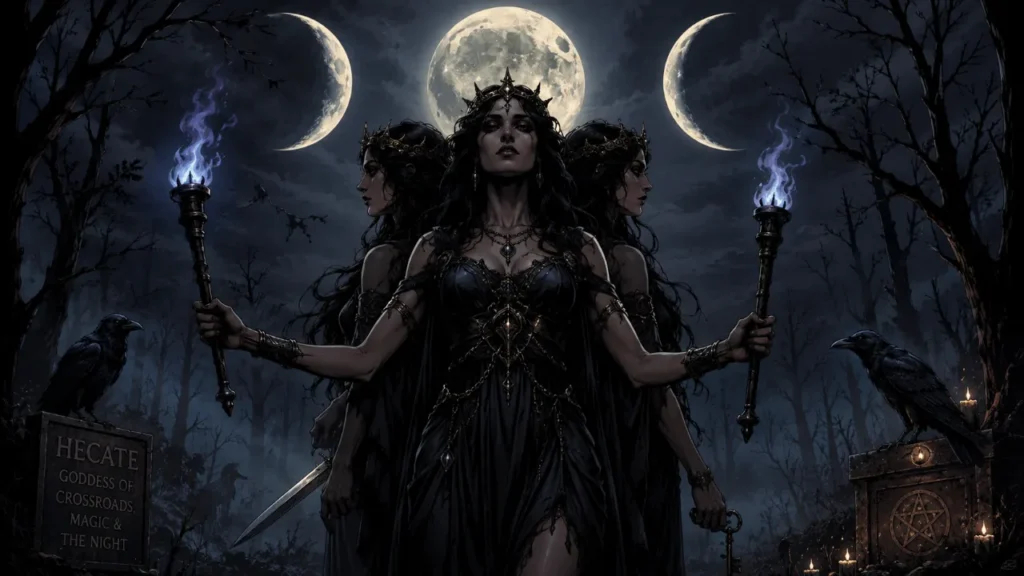
Hecate, also known as Hekate, is an ancient goddess traditionally associated with magic, spells, witchcraft, the night, and the moon.
She was worshipped in the ancient Greek world and later became an important figure in Roman religious traditions. From ancient occult text Hecate is the ancient Greek goddess of magic, witchcraft, crossroads, the night, and the underworld.
She is the daughter of the Titans Perses and Asteria. Unlike many other Titans who were cast out after the war with the Olympians, Zeus honored Hecate and allowed her to keep her vast dominion over the earth, sea, and sky.
As I often explain, the qualities and powers associated with a spiritual figure can sometimes matter more than the particular name used to describe that figure in different cultures.
From this perspective, Hecate can be compared with other powerful female figures associated with magic and mystery, including Isis in ancient Egypt, Baba Yaga in Slavic folklore, and Cliodhna in Celtic tradition.
Because of the lasting influence of ancient Greek and Roman traditions on Western spirituality and occult practices, Hecate remains one of the most recognised names associated with magic, witchcraft, crossroads, and spiritual transformation.
Many modern practitioners continue to honour her through prayers, offerings, meditation, and Hecate invocation rituals. There are some unque Powers and Symbols of goddess Hecate you can see here.
- Realms: She moves freely between the realms of the living, the gods, and the dead.
- Crossroads: She guards liminal spaces, particularly three-way crossroads where physical and spiritual worlds meet.
- Symbols: She is commonly associated with burning torches, keys, the dark moon, and sacred packs of dogs.
- Depiction: Later artistic traditions often show her as triple-bodied or triple-faced so she can look in multiple directions at once.
To help those who are interested in Hecate Summoning Rituals, I have shared a step by step easy ritual guide here and you can practice it.
It explains the ritual approach and provides steps that can be followed individually when seeking to invoke or connect with Hecate.
The purpose is to provide a simple starting point for anyone exploring Hecate rituals for beginners, while keeping the traditional symbolism and spiritual meaning at the centre of the practice.
- The Origin of Hecate the goddess of living and dead
- Difference between evoking vs Invoking Goddess Hecate
- How Hecate May Appear During a Ritual
- Signs during Hecate Rituals
- What Counts as a Successful Hecate Ritual?
- Preparing for a Hecate Summoning Ritual
- Why Prepare for Seven Days?
- The Best Time to Perform a Hecate Ritual
- Hecate Invocation: The Blood Serpent Ritual
- Hecate Evocation: The Great Triad Ritual
- Unique Powers and Abilities of Hecate
- 1. What are the main powers of Hecate Goddess?
- 2. Why is Hecate associated with crossroads?
- 3. Does Hecate have powers over the underworld and spirits?
- 4. Why is Hecate shown carrying torches?
- 5. What does the threefold form of Hecate represent?
The Origin of Hecate the goddess of living and dead
Hecate is one of the most fascinating and complex figures in the ancient religious world. Her earliest origins are generally associated with Thrace or Anatolia before she became established within Greek religious traditions.
In Hesiod’s Theogony, written around the 8th century BCE, Hecate is presented as a powerful goddess whose influence extends across the earth, sea, and sky.
Hecate was associated with roads, crossroads, and the protection of homes. At the same time, ancient traditions connected her with magic, spirits, ghosts, and the night.
This combination of roles reflects one of her most important characteristics: her connection with liminal spaces—places and moments that exist between one state and another, such as the boundary between the familiar and the unknown, or the visible and invisible worlds.
This dual nature makes Hecate particularly interesting to people exploring Hecate Summoning Rituals today. She was not simply viewed as a benevolent protector or a frightening supernatural figure.
Instead, she could represent both sides: protector and feared goddess, light and darkness, wisdom and danger.
This complex character also contributed to the way Hecate was interpreted in later periods. As attitudes toward ancient pagan deities changed, some of her associations with magic, spirits, and the night became increasingly connected with darker or demonic imagery.
Understanding this historical development is important before exploring Hecate invocation rituals or modern practices dedicated to her.
The Symbols of Hecate
In ancient and modern depictions, Hecate is often shown with objects and symbols that carry deeper meanings rather than serving as simple decorations. These symbols can help explain her traditional associations and provide context for people exploring Hecate Summoning Rituals.
🔥 The Torches — Hecate’s torches represent guidance through darkness and the ability to illuminate a path into the unknown. They can be understood as symbols of knowledge, direction, and finding one’s way through uncertain situations.
🗝️ The Keys — Keys are strongly associated with Hecate and can symbolise opening and closing doors, boundaries, and passages between different states or realms. In modern Hecate invocation rituals, keys are sometimes used as symbolic representations of access and transition.
🌙 The Moon — The moon represents mystery, cycles, change, and renewal. Its darker phase is particularly meaningful to many modern practitioners who connect Hecate with introspection, transformation, and the unknown.
🐕 The Dog — Dogs were closely associated with Hecate in ancient tradition and became one of her most recognisable sacred animals. Their alert and protective nature fits naturally with her association with boundaries and crossroads.
⚖️ The Crossroads — Crossroads are among the most important symbols connected with Hecate. They represent choices, transitions, uncertainty, and the meeting point between different paths.
Among these symbols, the moon can hold a particularly personal meaning. Its connection with cycles, mystery, transformation, and femininity makes it a powerful image for anyone developing a personal spiritual practice involving Hecate.
A personal object can also become meaningful within such a practice. For example, rose quartz may serve as a personal reminder of subtle change, intention, and the belief that transformation does not always have to be dramatic to be meaningful.
For those creating a Hecate altar for beginners, choosing a personal symbolic object can make the practice feel more intentional and personal.
Difference between evoking vs Invoking Goddess Hecate
For readers who already understand the difference between evocation and invocation, these terms may seem straightforward.
However, if you are new to ceremonial or occult terminology, understanding the distinction is important before attempting a Hecate ritual. The two approaches describe different ways of relating to a deity within a spiritual practice.
Evocation
Evocation is traditionally understood as calling a spiritual being or deity to appear or work from outside yourself.
In the context of Hecate, an evocation may be chosen when your intention is to seek guidance, opportunities, or changes in your external circumstances without making personal transformation the primary goal.
Some internal changes may naturally follow from the experiences you have, but the main focus of an evocation is directed towards something outside yourself.
This could involve seeking greater opportunities, relationships, knowledge, protection, or support for a particular magical or spiritual goal.
For example, someone working with Hecate might seek guidance in finding a suitable spiritual community, teacher, coven, or initiatory tradition.
Another person might ask for direction towards an environment that allows them to develop their spiritual interests. Someone interested in occultism as a profession might also use a ritual as a way of expressing an intention for new opportunities or a clearer direction in life.
These examples illustrate how Hecate evocation rituals can be approached as a symbolic practice focused on external circumstances, guidance, and personal goals.
Invocation
Invocation is traditionally understood as calling a deity or spiritual presence inward, allowing its qualities and symbolism to become part of your own experience.
In a Hecate invocation, the emphasis is therefore more strongly placed on inner development and transformation.
A practitioner might use a Hecate invocation ritual to deepen intuition, strengthen their connection with magic, develop confidence in their spiritual practice, or explore aspects of themselves associated with wisdom, transformation, boundaries, and the unknown.
In some modern occult traditions, practitioners believe that invoking Hecate can enhance their magical abilities and make their spiritual practices more effective.
Others understand the experience psychologically, viewing the ritual as a way to focus the mind, strengthen intention, and explore the deeper patterns influencing their thoughts and behaviour.
Another commonly described effect is a growing interest in magical and spiritual subjects.
Practitioners may also feel more inclined to examine the deeper causes and connections behind experiences in their lives.
The key distinction is simple: evocation focuses primarily on an external relationship or outcome, while invocation focuses more strongly on internal experience and transformation.
Understanding this difference can help you decide what type of approach fits your intention when exploring Hecate Summoning Rituals.
Read : The Dark Truth of Iblis Demon in Islam You Should Know 2 strange story around demon Iblis
How Hecate May Appear During a Ritual
When exploring Hecate Summoning Rituals, it is important to understand that practitioners may describe their experiences in very different ways. There is no single appearance or experience that everyone should expect.
In modern occult traditions, some people interpret unusual experiences as spiritual encounters, while others understand them through psychological, symbolic, or dream-related explanations.
Practitioners who work with Hecate have described experiences such as:
- experiencing a vivid vision or mental image
- seeing symbolic imagery while using a mirror or scrying tool
- feeling as though they hear a voice or receive a message
- experiencing a strong sense of Hecate’s presence
- having vivid or memorable dreams following the ritual
- noticing unusual sensations or events during meditation or ritual work
Dreams can be particularly significant for people who practise lucid dreaming or regularly record their dreams. A person may experience Hecate-related symbols, places, animals, or conversations and interpret them as part of their spiritual practice.
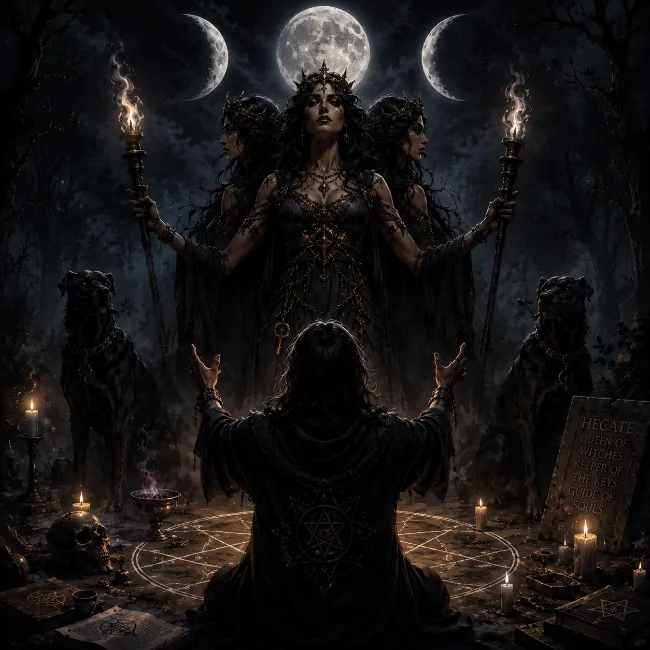
Signs during Hecate Rituals
Some practitioners also report unusual physical experiences during ritual work. These may include a candle flame appearing to move unexpectedly, sudden changes in temperature, unexplained sounds, or a feeling of air moving through the ritual space.
Such experiences are often interpreted within occult traditions as possible signs of spiritual activity.
However, they can also have ordinary explanations. Air movement, changes in room temperature, candle behaviour, building noises, and heightened attention can all affect what a person notices during an intense ritual.
For this reason, these experiences should not automatically be treated as proof that Hecate has appeared or that a supernatural portal has opened.
Some occult traditions describe ritual experiences using the idea of a portal between the physical world and a spiritual or subtle realm.
This is a spiritual interpretation rather than something that has been scientifically established.
Likewise, the belief that a ritual becomes stronger when several people combine their energy belongs to particular magical traditions and should be understood within that context.
What Counts as a Successful Hecate Ritual?
It is easy to become focused on dramatic experiences when performing a Hecate invocation ritual or Hecate evocation ritual.
However, unusual sights, sounds, candle movements, or physical sensations are not reliable measures of whether a ritual has achieved its purpose.
Instead, it can be more useful to focus on the intention behind the practice. What were you hoping to understand, change, explore, or gain from the experience? Did the ritual help you reflect on that intention?
Did you gain a new perspective or feel more connected to your spiritual practice?
For practitioners who believe in direct communication with Hecate, the meaning of the experience may ultimately be more important than how dramatic the experience appears.
With that understanding in place, we can now move to the practical part of this guide. The first stage is ritual preparation, which can be used as the foundation for both evocation and invocation practices involving Hecate.
Preparing for a Hecate Summoning Ritual
Preparation can be an important part of any Hecate Summoning Ritual. Taking several days to simplify your routine can help you become calmer, more focused, and more aware of your thoughts before beginning the ritual.
Our everyday habits can influence how we feel physically and mentally. Diet, sleep, screen time, sexual activity, stress, and the type of information we consume can all affect our concentration and overall sense of wellbeing. For this reason, some modern occult practitioners choose to follow a period of cleansing and self-discipline before an important spiritual practice.
The following six lifestyle changes can be used for around seven days before a Hecate ritual. They should be viewed as a spiritual preparation rather than strict requirements.
1. Keep Your Diet Light
During the preparation period, consider eating simple, light meals and avoiding foods that make you feel sluggish or uncomfortable. Some practitioners prefer a vegan or vegetarian diet, while others simply reduce their consumption of heavy foods and red meat.
The purpose is not to follow a particular diet perfectly. Instead, the idea is to make your meals simple enough that digestion does not become another distraction while you are preparing for your ritual.
2. Be Careful With Fasting
Some occult traditions include fasting as part of ritual preparation. However, a 24-hour water fast is not necessary for everyone and may not be suitable for some people.
If you are considering fasting, especially if you take medication, have a medical condition, are pregnant, have a history of disordered eating, or are otherwise unsure whether fasting is appropriate for you, speak with a qualified healthcare professional first. There is no need to put your health at risk for a spiritual practice.
For many people, simply eating lighter meals and avoiding unnecessary indulgence can provide a safer alternative.
3. Prioritise Sleep
Good sleep is one of the simplest ways to improve your ability to concentrate. During the seven-day preparation period, aim for around eight hours of sleep each night and maintain a consistent bedtime.
Keeping your bedroom dark and quiet can make it easier to rest. Rather than treating sleep deprivation as part of the ritual, approach proper rest as a way of arriving at your practice with a clear and attentive mind.
4. Reduce Sexual Distractions
Some practitioners choose to abstain from sexual activity during ritual preparation. Within certain occult traditions, this is regarded as a way of directing attention and intention towards spiritual work.
If you choose this approach, think of it as a temporary period of discipline rather than something that is inherently necessary for working with Hecate. The important point is to reduce distractions that prevent you from concentrating on your intention.
5. Take a Break from Mental Noise
Modern life provides almost unlimited sources of distraction. Social media, television, online games, constant notifications, and endless scrolling can make it difficult to spend quiet time with your own thoughts.
During the week before your Hecate invocation ritual, consider reducing unnecessary screen time and entertainment. You do not need to eliminate technology completely. Instead, create periods during the day when you can be quiet and undistracted.
Use this time to journal, reflect, read appropriate historical or spiritual material, or simply observe your thoughts.
If you enjoy grimoires or esoteric books, they can also become part of your preparation. However, there is no need to perform every ritual or spell you encounter while reading. Keeping your attention on one intention can make the preparation feel more focused.
6. Meditate and Become Familiar with Hecate’s Symbols
Meditation can help you develop concentration before attempting a Hecate summoning ritual for beginners. Even a short daily practice can give you time to slow down and observe your thoughts without immediately reacting to them.
You can also use this period to become familiar with traditional symbols associated with Hecate, such as the torch, key, dog, moon, and crossroads. During meditation, you might visualise Hecate according to your own understanding or reflect on what these symbols mean to you.
This does not guarantee that you will experience a supernatural presence. Rather, it gives your mind a familiar symbolic framework and helps you clarify what you hope to gain from the ritual.
Practices such as yoga, tai chi, qigong, or simple breathing exercises can also be useful if they are already part of your routine.
Read : Who is Marchosias Demon in the Lesser Key of Solomon 5 Strong and Positive reason working with him
Why Prepare for Seven Days?
Following a seven-day preparation period requires commitment, but it does not have to become a permanent lifestyle.
The intention is to temporarily simplify your routine so that you can approach the ritual with greater focus and a clearer understanding of what you want.
You may also discover that some of these habits—better sleep, less screen time, meditation, journaling, or mindful eating—are valuable beyond the ritual itself.
Most importantly, do not measure devotion by how much discomfort you can tolerate. A meaningful spiritual practice does not require you to harm yourself or ignore your physical needs.
Preparation is about creating clarity and intention, not punishment.
Once this preparation is complete, you can move on to the next stage: creating the ritual space and gathering the items you want to use for your Hecate Summoning Rituals.
The Best Time to Perform a Hecate Ritual
The ideal time for a Hecate Summoning Ritual depends largely on the magical tradition or personal practice you follow.
Different practitioners recommend different times, including midnight, 10 p.m., 3 a.m., the full moon, or particular lunar events. Some groups even choose a specific moon, such as the Cold Moon, for their Hecate rituals.
There is no single time that is universally required.
The importance given to timing varies between magical systems, and many modern practitioners choose a time based on personal preference, symbolism, and the atmosphere they want to create.
From a practical perspective, choosing a time when you can remain calm, focused, and undisturbed may be more important than following a strict clock-based rule.
Ritual timing can provide a meaningful structure, but it should not become so complicated that it makes the practice unnecessarily difficult.
Is Midnight the Best Time for Hecate?
Night-time has a strong symbolic connection with Hecate. Ancient and later traditions associated her with darkness, the night, crossroads, spirits, magic, and transitions. Because of these associations, many people who practise Hecate invocation rituals prefer to work after sunset.
Midnight is particularly popular because it creates a quiet and reflective atmosphere. Fewer distractions, reduced noise, darkness, and the natural stillness of the night can make it easier to concentrate on meditation, prayer, or ritual work.
Some practitioners also report feeling a stronger personal connection with Hecate when performing rituals around midnight. This is a matter of individual spiritual experience rather than something that can be objectively guaranteed.
Do You Need to Wait for the Full Moon?
Not necessarily. Although the moon is an important symbol in modern representations of Hecate, there is no universal rule requiring every Hecate ritual for beginners to be performed during a full moon.
If a particular lunar phase has personal or traditional significance for you, incorporating it into your practice can make the ritual more meaningful.
Likewise, those interested in historical Hecate worship may wish to research practices associated with the lunar cycle and the Deipnon, traditionally connected with Hecate and the dark moon period.
Ultimately, choose a time that supports your intention and allows you to perform the ritual safely and without unnecessary distractions.
For my own approach, nighttime—particularly around midnight—is the preferred setting for working with Hecate. It fits naturally with her traditional associations with the night and creates the quiet atmosphere I find most suitable for spiritual practice.
The most important thing is not finding a supposedly perfect hour. It is approaching the ritual with a clear intention, a focused mind, and respect for the tradition you are practising.
Hecate Invocation: The Blood Serpent Ritual
The following is a modern occult-style Hecate invocation ritual centred on symbolism, meditation, focused breathing, and the imagery of a “blood serpent.” The ritual should be understood as a spiritual practice rather than a scientifically verified method of summoning or invoking a supernatural being.
Required Ritual Tools
- An altar or suitable table
- A ritual dagger or symbolic ceremonial knife
- One red rose
- One black candle and one dark-red candle
- A chalice or suitable cup
- Red wine, if you choose to use alcohol
- Salt
- Black storax incense
- Red or purple ritual robes
- Red or purple body paint
If you use incense or candles, keep them on a stable, heat-resistant surface and never leave an open flame unattended.
1. Set Up the Altar
Begin by putting on your ritual robes and preparing your altar. You do not need a traditional altar; a clean desk, table, or similar surface can work just as well.
Arrange the objects as follows:
- Place the chalice in the centre and fill it with wine.
- Put the black candle to the left and the dark-red candle to the right of the chalice.
- Place the dagger and rose in front of the chalice.
- Leave sufficient space between the objects to reduce the risk of knocking them over or creating a fire hazard.
Light the candles and incense only when everything is securely positioned.
2. Mark the Ritual Space
A ritual circle is traditionally used in many magical systems to distinguish the ritual space from its surroundings. In an invocation, the practitioner may choose to remain within the circle as part of the symbolic experience of bringing the deity’s qualities inward.
Salt is one traditional material sometimes used when marking ritual boundaries.
To create a simple circle:
- Place or pour a small amount of salt around the area where you will perform the ritual.
- Leave enough room inside the circle for you to stand and move comfortably.
- Use a stick or another suitable object to define the boundary clearly.
The circle can be understood symbolically as a boundary that helps you focus your attention and separate ritual time from ordinary activities.
3. Get Into the Right Frame of Mind
Before beginning the invocation, spend several minutes preparing your mind and body.
Lie down somewhere comfortable outside the ritual circle and practise slow, controlled breathing:
- Inhale for 4 seconds.
- Hold for 4 seconds.
- Exhale for 4 seconds.
- Hold for 4 seconds.
Continue this pattern for approximately 10 minutes, stopping if you feel dizzy, uncomfortable, or short of breath. Controlled breathing can help some people relax and become more attentive, although it should not be treated as a guaranteed treatment for anxiety.
When you finish, sit up slowly and say either aloud or silently:
“I’m awake!”
Using the body paint, you can then draw a circle crossed by a horizontal line on the forehead, between the eyebrows. In modern spiritual practices, this area is sometimes associated with the “third eye” and intuition.
4. Perform the Invocation
Once you feel calm and focused, approach the altar. Hold the ritual dagger carefully and move it counterclockwise around the candles and chalice, with the tip pointing downward.
As you perform this movement, repeat the following incantation seven times:
Hecaten ad haec aras accedet! Hunc calicem cum spiritu tuo Hecate fascinare!
If you do not speak Latin, do not become overly concerned about achieving perfect pronunciation. You can research the wording and pronunciation beforehand and treat the recitation as part of the ritual’s symbolic structure.
Next, remove several petals from the rose and place them in the wine. Only use rose petals that are specifically sold or prepared as food-grade and safe for consumption. If you are unsure, simply place the rose beside the chalice instead.
If you choose to drink the wine, do so slowly and responsibly. You can use the symbolism of the ritual to imagine that you are taking the essence or qualities associated with Hecate into yourself. Visualise this essence moving downward from your throat into your stomach like a symbolic blood serpent.
Pay attention to your breathing, bodily sensations, thoughts, and emotions without assuming that every sensation has a supernatural cause.
The next part involves the words of power, or enn, used in some modern occult traditions:
Anana Hekate Ayer
Repeat the enn while maintaining your focus on the ritual. Some practitioners use repetitive chanting to enter a deeper meditative or altered state of awareness.
Afterward, move away from the ritual space and lie down again. Rather than deliberately forcing yourself to shake, scream, or lose control, allow any natural physical sensations to occur without putting yourself or anyone else at risk.
The original practice describes this stage as a way of temporarily letting go of conscious control and becoming more immersed in bodily awareness. A safer interpretation is to observe your physical responses without deliberately provoking extreme behaviour.
Remain aware of your surroundings and stop if you experience pain, severe dizziness, difficulty breathing, confusion, or anything that feels unsafe.
When you feel settled again, get up slowly and repeat:
“I’m awake!”
Read : 3 Most Powerful Ritual for Working with Lucifer
5. End the Ritual
Once the invocation is complete, take time to close the ritual space properly.
Put out the candles and incense safely, remove the objects from the altar, and store your ritual items somewhere clean and respectful. Clear away the salt and tidy the area.
Open a window if conditions allow and spend some time outside afterward. A gentle walk for 20–30 minutes can help you transition back into your normal routine.
Try not to obsessively analyse every sensation or event immediately after the ritual. Instead, give yourself some quiet time and write down anything you remember in a journal.
From a spiritual perspective, practitioners may interpret the experience as developing a deeper connection with Hecate. From a psychological perspective, the ritual can also be viewed as an intense period of focused attention, visualisation, symbolism, and self-reflection.
What matters most is how you understand the experience and whether it helps you reflect on the intention that brought you to the ritual in the first place.
For anyone exploring Hecate Summoning Rituals, this ritual is best approached with respect, preparation, clear intention, and awareness that spiritual experiences can be interpreted in different ways.
Hecate Evocation: The Great Triad Ritual
The Great Triad Ritual is a modern-style Hecate evocation practice built around three candles, an amethyst stone, geometric ritual symbols, visualisation, and spoken invocations. In this form of Hecate evocation ritual, the practitioner remains separated from the symbolic space where Hecate is invited to appear.
The ritual uses colours and objects to represent different aspects traditionally or symbolically associated with Hecate.
Required Ritual Items
- Salt
- Three candles: silver, green, and red
- An amethyst pyramid or amethyst sphere
- A wand made from wood or metal
- A ceremonial blade, such as a dagger or sword
- Red, black, purple, or violet ritual robes
The Meaning behind the Symbols
Amethyst is used in this ritual as a symbolic representation of Hecate. The stone is treated as a focal point that the practitioner charges through ritual movements, visualisation, and incantation.
The three candles also have specific symbolic meanings:
- Silver represents Hecate’s connection with the moon, night, and witchcraft.
- Green represents healing, renewal, and rejuvenation.
- Red represents strength, determination, and assertive energy.
- Purple or violet, represented by the amethyst, symbolises royalty and the joining together of these different qualities.
The pyramid is used as a visual and symbolic focal point. Some occult traditions attribute special energetic properties to pyramid shapes, although claims that pyramids objectively attract or accumulate supernatural energy have not been scientifically established. In this ritual, its primary function is to provide a clear centre for concentration and visualisation.
1. Mark the Circle and Triangle
Put on your ritual robes and dim the lights. Candlelight can be used to create a quieter and more focused atmosphere.
For the evocation, mark two shapes on the floor: a circle and an equilateral triangle. The triangle should be positioned so that it is clearly separate from the circle, leaving enough space for you to move safely.
The triangle represents the area where Hecate is symbolically invited, while the circle represents the space occupied by the practitioner. Unlike an invocation, where the deity is symbolically brought inward, the purpose here is to maintain a clear distinction between the practitioner and the evocation space.
Use salt to mark the circle if that is part of your chosen tradition.
2. Prepare and Position the Candles
Before lighting the candles, mark them with the following symbols:
- Α (Alpha) on the green candle
- Ω (Omega) on the red candle
- Δ (Delta) on the silver candle
Place one candle at each point of the triangle.
When viewed from inside the circle, position the:
- Green candle on the left
- Red candle on the right
- Silver candle at the remaining point
Place the amethyst pyramid in the centre of the triangle.
Light the candles carefully and make sure they are positioned on stable, heat-resistant surfaces with sufficient space between them.
3. Focus and Direct Your Intention
Stand inside the circle with the wand and ceremonial blade. For the remainder of this stage, maintain your position inside the circle.
Face the triangle and, using the blade carefully, trace an inverted pentagram in the air as a symbolic gesture.
Next, visualise the pentagram moving towards the triangle. Imagine it becoming smaller until it can be contained within the amethyst pyramid.
While performing this visualisation, repeat Hecate’s enn:
“Anana Hekate Ayer!”
Put the blade down safely and take the wand.
The next visualisation focuses on shifting your attention from the head towards the heart. Imagine that your usual point of awareness has moved into the centre of your chest. Some practitioners describe this as creating a different or heightened sense of perception.
Visualise a flame burning within your heart.
Raise the wand towards the three candles and imagine this inner flame travelling first towards the green candle, then the red candle, and finally the silver candle.
As you direct your attention towards each candle, say:
“Accende flammam impia!”
This stage is best understood as a concentration exercise in which colour, movement, words, and visualisation are combined to create a strong mental focus.
4. Evoke Hecate Through the Pyramid
Point the wand towards the amethyst pyramid and close your eyes, or keep them slightly open if that feels more comfortable.
Visualise rays of green, red, and silver light travelling from the three candles towards the pyramid. Imagine the energy gathering inside it and becoming increasingly luminous.
Next, visualise a powerful violet ray rising from the pyramid towards the sky. Imagine a golden ray returning from above and entering the pyramid.
As the visualisation develops, picture the pyramid becoming brighter and the light expanding until it fills the entire triangle.
Then say:
“Hecate, I summon thee into the triangle! I wish to communicate to you my thoughts and desires. I ask that you help me in this hour of need!”
Keep the wand directed towards the pyramid as you continue the visualisation. Within the symbolic framework of the ritual, the wand represents the connection between your intention and the evocation space.
The idea that this creates a literal energetic barrier that prevents a spirit from influencing you is a matter of occult belief rather than an established fact. For that reason, remain grounded and aware of your surroundings throughout the practice.
5. Communicate With Hecate
Once the evocation has been established, communicate your request clearly and calmly.
You can keep your eyes closed or gaze softly towards the triangle. Focus on your intention and observe whatever thoughts, emotions, images, or sensations arise.
People who practise modern occult rituals sometimes interpret experiences such as vivid imagery, unusual sounds, chills, warmth, shivering, changes in heartbeat, or other strong sensations as signs of a spiritual presence. These experiences can also have psychological or physical explanations, particularly during prolonged concentration, chanting, meditation, or heightened emotional states.
You may also experience thoughts or words appearing spontaneously, almost as though they are coming from somewhere outside your conscious control. Rather than automatically treating this as proof of communication with Hecate, record the experience and reflect on its meaning afterward.
The goal of this stage is to communicate your intention and remain attentive to your experience without forcing a particular result.
6. End the Evocation
When you are ready to finish, lower the wand so that it is no longer pointing towards the triangle.
Say:
“I end the ritual with greatest reverence towards you, goddess Hecate. May my desires be fulfilled through your power and blessing. Hail Hecate!”
Take a moment to become fully aware of your surroundings before leaving the circle.
Extinguish the candles safely, clear away the salt, clean the ritual area, and store your ritual objects in an appropriate place. If incense has been used, make sure it is completely extinguished.
Opening a window can provide fresh air and help mark the transition from ritual time back to ordinary activity.
Afterwards, return to your normal routine. You may also write down your experience, particularly any dreams, thoughts, symbols, or insights that stood out to you.
Whether you understand the experience spiritually, symbolically, or psychologically, keeping a record can help you recognise patterns over time.
For those exploring Hecate Summoning Rituals, the Great Triad Ritual is best approached as a structured practice of intention, symbolism, visualisation, and meditation rather than as a guaranteed supernatural method. Clear preparation and a calm state of mind are more useful than trying to force a dramatic experience.
Read : Exploring the 2 Powerful Leviathan Summoning Ritual: Myth, Magic, and Mystery
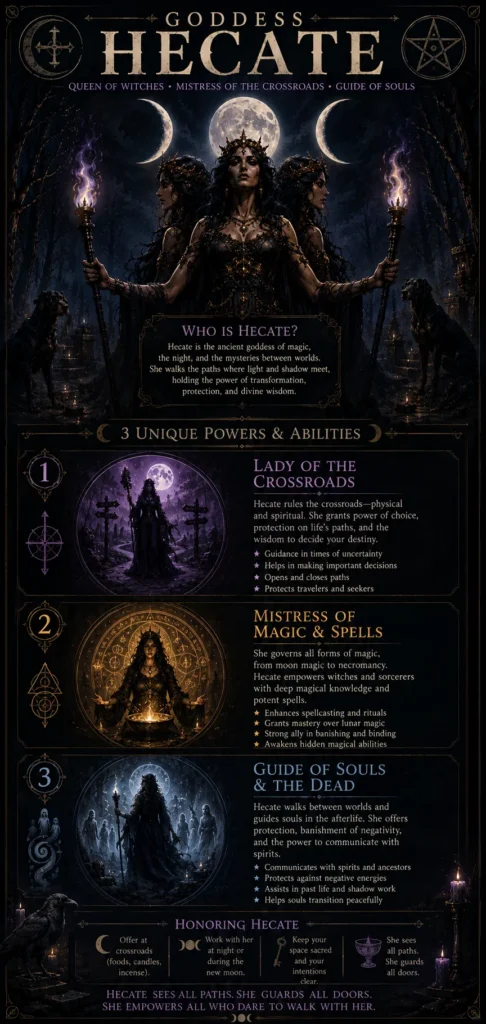
Unique Powers and Abilities of Hecate
- Goddess of Magic: Hecate is strongly associated with witchcraft, magical practices, spells, and hidden mystical knowledge.
- Guardian of Crossroads: She is traditionally connected with crossroads, representing important choices, transitions, and different paths in life.
- Keeper of Thresholds: Hecate is viewed as a guardian of boundaries, doorways, gates, and places where one state or realm meets another.
- Connection to the Underworld: Ancient traditions associate Hecate with the underworld and the realm of spirits, giving her a role as a guide between worlds.
- Night and Darkness: Her connection with nighttime represents mystery, the unseen, intuition, and knowledge hidden from ordinary perception.
- Moon Association: Hecate became closely connected with lunar symbolism, particularly themes of cycles, change, renewal, and transformation.
- Spirit Guidance: She is traditionally associated with ghosts and spirits and is sometimes portrayed as a supernatural guide through mysterious or liminal spaces.
- Protection: Hecate was worshipped as a protective deity, particularly in connection with homes, entrances, journeys, and vulnerable boundaries.
- Transformation: Her symbolism reflects endings, new beginnings, personal change, and periods of major transition.
- Threefold Nature: Hecate is famously represented in triple form, symbolising different stages, directions, perspectives, and the passage between past, present, and future.
- Hidden Wisdom: She represents the pursuit of knowledge that lies beyond ordinary understanding, especially mysteries connected with magic, nature, and the unseen.
- Guide Through Change: Hecate’s symbolism makes her a powerful figure for those facing crossroads, uncertainty, endings, and new beginnings.
Read : 4 Ancient yet effective Mammon Prayers for Money, Debt Relief and Wealth
Hecate goddess summoning ritual conclusion
Although I created these Hecate Summoning Rituals myself, they were not developed without inspiration or structure.
The main elements were adapted from several ceremonial and spiritual traditions, including the Hermetic Order of the Golden Dawn, as well as older pagan, theurgic, and shamanic practices.
While developing the rituals, I removed some requirements that I considered unnecessary or difficult to apply in a modern setting.
Certain magical traditions place considerable emphasis on atmospheric details such as fragrances, elaborate decorations, gemstones, specific clothing, and other ceremonial elements. These can certainly add atmosphere, but they are not always essential to the central purpose of a ritual.
The same applies to ritual locations. Older traditions often attached great spiritual importance to particular temples, sacred landscapes, crossroads, forests, or other locations.
Places such as Delphi held enormous religious significance for ancient Greeks, for example, but that significance cannot necessarily be reproduced simply by visiting the location today.
For a modern practitioner, the meaning of a place is often shaped by personal experience and cultural background.
A quiet room, private outdoor space, or another location where you can concentrate without interruption may therefore be more practical than attempting to recreate an ancient sacred setting.
Traditional rituals can be beautiful and culturally meaningful. They can also provide a connection with the history of ancient pagan and magical practices. However, they are not the only way to approach Hecate.
The rituals presented in this guide preserve elements that I consider meaningful—such as symbolism, intention, visualisation, ritual boundaries, candles, and invocation—while adapting them for contemporary practice.
In this way, modern Hecate rituals can retain a connection with older traditions without requiring every historical detail to be reproduced exactly. The result is a more accessible approach for someone who wants to explore Hecate invocation and evocation rituals in a modern setting.
Frequently Asked Questions About Hecate Goddess
1. What are the main powers of Hecate Goddess?
Hecate is traditionally associated with magic, witchcraft, the night, ghosts, crossroads, and the underworld. Ancient traditions also connect her with protection, hidden knowledge, spiritual boundaries, and guidance during times of transition. Her powers were not limited to magic; older traditions describe her as a goddess who possessed influence across heaven, earth, and sea.
2. Why is Hecate associated with crossroads?
Crossroads are one of Hecate’s most important symbols. They represent places where different paths meet and choices must be made. Hecate was known by titles meaning “of the crossroads” and “of the wayside.” Her connection with these places also reflects her broader role as a guardian of boundaries and transitions.
3. Does Hecate have powers over the underworld and spirits?
Hecate became strongly associated with the underworld, ghosts, and the souls of the dead, particularly in later Greek traditions. She was also described as a night-wandering goddess accompanied by supernatural beings. Her role was therefore connected with the boundary between the living world and the realm of the dead.
4. Why is Hecate shown carrying torches?
The torch is one of Hecate’s most recognizable symbols. In the Homeric Hymn to Demeter, Hecate carries a torch while helping Demeter search for Persephone. This imagery later became associated with her role as a guide through darkness, mystery, and the underworld. Ancient artwork frequently depicts her holding two torches.
5. What does the threefold form of Hecate represent?
Hecate was often represented in triple form, with three bodies or three aspects facing different directions. This imagery is particularly connected with crossroads and her ability to look in multiple directions. In modern interpretations, her threefold form is often linked symbolically with different stages of life, transformation, and the passage between different states or paths, although these interpretations should be distinguished from ancient evidence.