
Jikininki or Human Eating Ghost. Have you ever heard about Jikininki, or the human-eating ghost? They are considered one of the many tamasic or dark entities believed to dwell in cremation grounds and are also described as greedy spirits.
A Jikininki is described as the demonic spirit of a hungry ghost that is believed to be created when a greedy, selfish, or unrighteous person dies.
It is believed that if a person lives a life of wrongdoing and dies consumed by selfishness and greed, their soul is cursed after death and condemned to search for and eat human beings and human corpses.
Islam contains accounts of ghouls, and similarly, different religions have traditions describing entities that remain cursed after death and are forced to consume human flesh.
A similar story can be found in Ueda Akinari’s 1776 collection Ugetsu Monogatari, where such a figure appears as “Aozukin.”
Japanese culture has produced many such stories that describe demonic entities, including Jikininki, which are said to constantly search for human flesh.
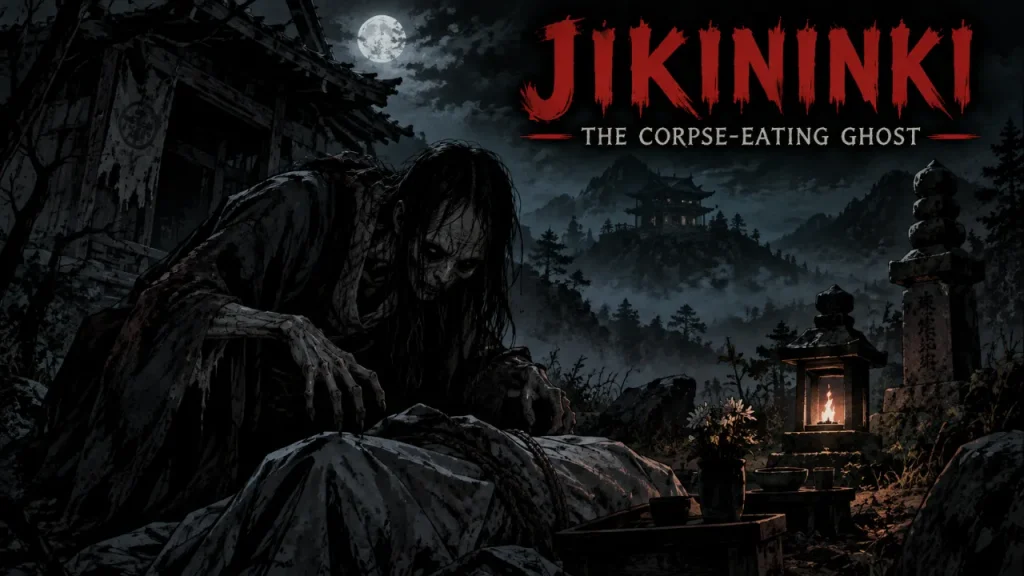
When a person dies after being consumed by greed and selfishness during their lifetime, their soul is believed to become cursed, forcing it to wander and consume human flesh.
The hunger of the Jikininki Human-Eating Ghost is believed to continue for eternity, with their own actions becoming an obstacle to their liberation. This belief originated in Japanese Buddhist traditions, where such stories were used to teach people about the consequences of greed and selfishness.
In the Garuda Purana, different forms of punishment are described based on a person’s actions, with the primary purpose of discouraging people from committing such deeds.
Similarly, in Buddhism, the legend of the Jikininki Human-Eating Ghost is used to encourage people to stay away from greed and selfishness. Let us explore in detail the legend of Jikininki, the human-eating ghost, and learn more about this fascinating figure from Japanese folklore.
Jikininki-Human Eating Ghost
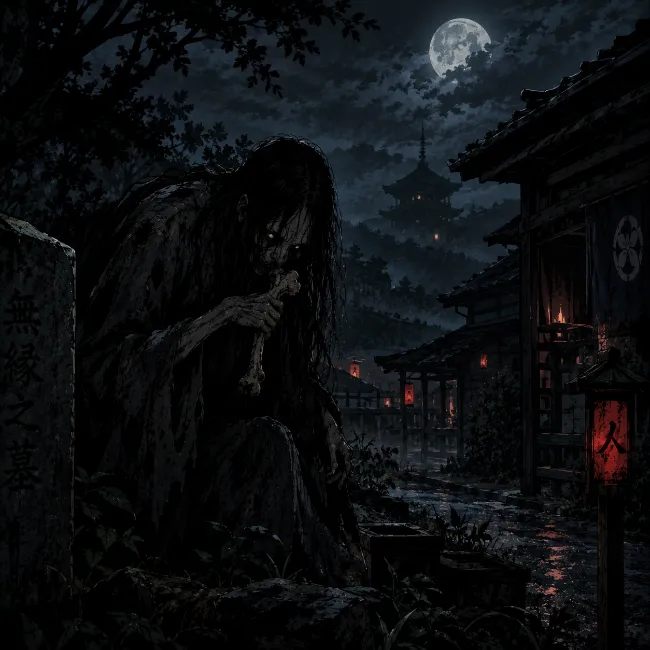
Jikininki are portrayed as terrifying creatures with thin, skeletal bodies, rotting flesh, and demonic faces.
They are said to wander through graveyards and battlefields, searching for fresh corpses to eat.
Their eyes glow with a terrifying light, and their movements are often described as slow and deliberate, weighed down by the burden of their eternal hunger.
Despite their frightening appearance and horrifying diet, Jikininki (Jikininki-Human Eating Ghost) are often portrayed as pitiful creatures who are fully aware of their cursed condition and the disgust it causes.
This self-awareness adds a layer of tragedy to their existence, as they are unable to escape the terrible fate they brought upon themselves through their past actions.
Read : The Truth Behind the Deal With the Devil: 8 Celebrities Who Claim They Sold Their Souls
The Origin Story of the Jikininki
The roots of the Jikininki-Human Eating Ghost can be traced back to Japanese culture.
It is said that there was a monk named Muso who was traveling alone through the mountains of Mino Province in Japan when he lost his way.
It was almost dark when he noticed an old anjitsu (literally, “hermit dwelling”), a place where solitary priests lived, on a mountain.
He climbed to the top of the mountain and asked the resident if he could stay for the night.
The only resident was an old priest who firmly refused to let Muso stay for the night. However, he told Muso that he could find food and a place to sleep in a nearby village.
Muso found the village, where the headman welcomed him and immediately provided him with food and a place to sleep.
Shortly before midnight, Muso was awakened by a young man from the village, who told him that his father had died earlier that day, before Muso arrived.
The young man had not told Muso earlier because he did not want to embarrass him or make him feel obligated to participate in the funeral ceremonies.
However, the entire village was now leaving their homes and going to a nearby village because it was customary to leave the body alone for the night; otherwise, the villagers believed that something bad might happen to the residents.
As a priest, Muso told the young man that he would fulfill his duty by performing the funeral rites and staying with the body throughout the night. He was not afraid of the demons or evil spirits the young man had warned him about.
After the young man and the other villagers left, Muso knelt beside the body and the offerings and began the service.
During the deepest part of the night, at ushi no toki, an amorphous creature—the Jikininki-Human Eating Ghost—entered while Muso was in deep meditation.
When Muso saw the shapeless creature eating the corpse and the offerings, he was unable to speak or move. The following morning, when the villagers returned, Muso told the young man what had happened.
The young man was not surprised.
Muso then asked him why the priest on the nearby mountain had not performed the funeral ceremony.
Confused, the young man told Muso that there was no priest living nearby and that there had not been one there for many years. When Muso mentioned the anjitsu, the young man also denied that it existed.
Muso then left the village, having finally received proper directions to continue his journey.
However, before leaving the area, Muso decided to visit the anjitsu and the old priest at the top of the mountain to find out whether he had been mistaken. He easily found the mountain and the anjitsu, and this time, the old priest allowed him inside.
The old priest then began apologizing before revealing his true form. He was the same shapeless creature that Muso had seen eating the corpse the previous night.
The old priest explained that he had now become a Jikininki (Jikininki-Human Eating Ghost) and revealed how it had happened. After living a long and selfish life as a priest, caring only about the food and clothing he received—even at the expense of those who were in need—he was reborn after death as a Jikininki.
The Jikininki-Human Eating Ghost was cursed to feed on the fresh corpses of others.
The old priest then begged Muso to perform a Segaki requiem service for him so that he could finally escape his terrible existence as a Jikininki.
As Muso performed the service, the old priest suddenly disappeared, along with the anjitsu. Muso found himself kneeling in the tall grass at the top of the mountain, in front of the grave of a priest and the ruins of the anjitsu.
Read : Is The Red Room Curse Real? The Story Behind the Japanese Internet Legend
Can Offerings Protect You From a Jikininki?
Offering gifts to a Jikininki (Jikininki-Human Eating Ghost) is not common because they are considered malevolent beings.
However, in folklore, food or prayers are often offered to Jikininki in an attempt to appease them or drive them away.
These acts are performed to provide some comfort to troubled spirits and protect the living from their wrath.
Offerings typically include rice, alcohol, and other staple foods, which symbolize sustenance and respect for the dead.
These rituals, sometimes described as a Jikininki-Human Eating Ghost offering ritual, are often performed during specific occasions, such as Obon, a festival dedicated to honoring ancestors. They are intended to help ensure that the spirits remain peaceful and do not harm the living.
Read : Mysterious Doppelganger encounter in everyday life 5 amazing fact you need to know
Conclusion
The Jikininki-Human Eating Ghost is one of the most disturbing and fascinating figures found in Japanese folklore. Stories of these cursed spirits connect greed, selfishness, and wrongdoing with a terrifying existence after death, making the Jikininki a powerful symbol of the consequences of one’s actions.
From their frightening appearance and endless hunger to the story of Muso and the old priest, the legend presents a mysterious connection between human actions, death, and spiritual consequences.
Traditions surrounding offerings, prayers, and requiem services further reflect the belief that troubled spirits can find peace and that the living can remain protected from supernatural forces.
Although the Jikininki-Human Eating Ghost remains a figure of folklore and legend, its stories continue to capture people’s imagination.
More than a terrifying human-eating ghost, the Jikininki represents a warning about the destructive nature of greed and selfishness and the importance of compassion toward others.
Frequently Asked Questions About Jikininki-Human Eating Ghost
1. What is a Jikininki-Human Eating Ghost?
A Jikininki-Human Eating Ghost is a supernatural figure from Japanese Buddhist folklore, commonly described as a spirit condemned to feed on human corpses. Jikininki are traditionally associated with people who lived selfish, greedy, or impious lives and were reborn after death into this cursed state.
2. Why do Jikininki eat human corpses?
According to Japanese folklore, Jikininki are cursed with an endless hunger for the dead. Their condition is connected to greed, selfishness, and improper conduct during their previous human life. The stories portray their hunger as a punishment rather than something they willingly choose.
3. What does a Jikininki look like?
Descriptions of Jikininki vary between different retellings. They are generally portrayed as frightening, ghost-like or humanoid creatures associated with death and corpse-eating. Some modern descriptions emphasize decayed or monstrous features, while the best-known traditional story of Musō initially describes the Jikininki as a vague or shapeless figure.
4. What is the story of Muso and the Jikininki?
One of the best-known Jikininki stories tells of the priest Musō, who stayed with the corpse of a recently deceased villager. During the night, he witnessed a mysterious creature devouring the corpse and funeral offerings.
Musō later discovered that the creature was actually an old priest who had been reborn as a Jikininki because of his selfish conduct. The old priest asked Musō to perform a Segaki service for him, after which both the priest and his hermitage disappeared.
5. Is the Jikininki legend connected to Buddhism?
Yes. The Jikininki tradition is closely associated with Japanese Buddhist ghost lore and ideas about karma, rebirth, greed, and spiritual consequences.
Jikininki are often discussed alongside gaki, or hungry ghosts, although the two are not identical in traditional classifications. Buddhist ghost-feeding rites known as Segaki are also associated with traditions concerning hungry spirits.